Emirates world’s first airline to operate A380 demo flight with 100% SAF
Demonstration flights like the one conducted today pave the way for future standardisat
qualification and adoption for 100 per cent SAF flying, as governments adopt broader
strategies to support the production and scale up of SAF. The A380 demonstration flight
underlines the performance and compatibility of SAF, making it a safe and reliable fuel
source.
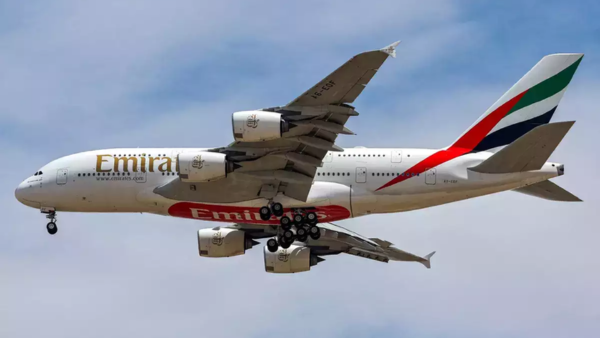
Emirates has become the world’s first airline to operate an A380
demonstration flight using 100 per cent Sustainable Aviation Fuel (SAF).
The flight took off today from Dubai International Airport (DXB) with
one of four engines powered on 100 per cent SAF, helping demonstrate
its potential as a drop-in replacement that matches jet fuel’s technical
and chemical requirements, while being a more sustainable alternative.
Notably, SAF can reduce carbon emissions by up to 85 per cent over the
fuel’s life cycle when compared to conventional jet fuel.Demonstration flights like the one conducted today pave the way for future standardisation, qualification and adoption for 100 per cent SAF
flying, as governments adopt broader strategies to support the
production and scale up of SAF. The A380 demonstration flight
underlines the performance and compatibility of SAF, making it a safe
and reliable fuel source SAF is currently capped at a 50 per cent blend limit in engines for
commercial flightsThe Emirates A380 demonstration flight comes as the aviation industry,
international organisations, regulatory bodies and high-level officials
driving policy-related decisions converge in Dubai for the Third
International Civil Aviation Organization (ICAO) Conference on Aviation
and Alternative Fuels (CAAF/3). Dedicated collaborators from Airbus,
Engine Alliance, Pratt &Whitney, Neste, Virent and ENOC have been
working on the testing, technical assessments and data analysis for this
flight.
The 100 per cent drop-in SAF used on Emirates flight includes
renewable aromatics and closely mimics the characteristics of
conventional jet fuel. This is the first time that drop-in SAF has been
used on an A380 aircraft, with the expectation of full compatibility
across the aircraft’s existing systems As per the official release, the flight carried four tonnes of SAF,
comprised of HEFA-SPK provided by Neste (hydro processed esters and
fatty acids synthetic paraffinic kerosene) and HDO-SAK from Virent
(hydro deoxygenated synthetic aromatic kerosene). ENOC helped to
secure the neat SAF comprised of HEFA-SPK, and blended it with
Sustainable Aviation Kerosene (SAK) at its facility in Dubai International
Airport ahead of the demonstration, and also carried out into-plane
services.
The 100 per cent SAF was used in one Engine Alliance GP7200 engine,
while conventional jet fuel was used in the other three engines. The
PW980 auxiliary power unit (APU) from Pratt &Whitney Canada also
ran on 100 per cent SAF.
Last week, robust engine testing for one A380 Engine Alliance GP7200
engine using 100 per cent SAF was carried out, with the objective of
validating the engine’s capability to run on the specially blended 100 per
cent drop-in SAF without affecting its performance or requiring any
modifications. Ground engine testing took place at the Emirates
Engineering Centre in Dubai.“The growing global demand for lower-emission jet fuel alternatives is
there, and the work of producers and suppliers to commercialise SAF
and make it available will be critical in the coming years to help Emirates
and the wider industry advance our path to lower carbon emissions,” Al
Redha added.
“Seeing Emirates flying an A380, the world's largest airliner, powered by
an engine running on 100 per cent Sustainable Aviation Fuels is a
symbolic moment. These fuels are the most effective way to address
CO2 emissions in the aviation industry today and that they are supported
increasingly by the world's leading airlines. SAF is vital to meeting the
sector's target of net-zero emissions in 2050, but needs the backing of
the whole industry. At Airbus, we are working to make all our aircraft
100% SAF-capable by 2030,” stated Julie Kitcher, Airbus Executive Vice
President Communications and Corporate Affairs.
“We're also working with partners to grow the global SAF market in the
coming years. Airbus's purpose as a company is to pioneer sustainable
aerospace for a safe and united world. Through our partnership with
Emirates, we're matching ambition with action.”
“Increasing the use of SAF is critical to achieving the goal of net-zero
in the decades ahead.”
Virent President and General Counsel Dave Kettner said that it’s critical
that a consortium of companies, like Emirates, come together to bring
sustainable aviation fuel into more widespread use. “Virent will continue
to collaborate with future-focused companies, and through this
collaboration we can continue to reduce emissions and power a more
fuel-efficient airline industry.”
Earlier this year, Emirates successfully completed the first 100 per cent
SAF-powered demonstration flight in the region on a GE90-powered
Boeing 777-300ER.
Last month, the first Emirates flights operating with SAF provided by
Shell Aviation took off from Dubai International Airport (DXB). Shell
supplied 315,000 gallons of blended SAF for use at the airline’s hub in
Dubai.
The airline also recently expanded its partnership with Neste for the
supply of over 3 million gallons of blended SAF in 2024 and 2025 for
flights departing from Amsterdam Schiphol and Singapore Changi
airports.GCAA, the airline contributed to the development of the UAE’s powerto-liquid (PtL) fuels roadmap, driven by the UAE Ministry of Energy and
Infrastructure and the World Economic Forum, and has been an active
participant in the UAE’s National Sustainable Aviation Fuel Roadmap
launched in January 2023 by the Ministry of Energy and Infrastructure
and GCAA.