Govt aims for $800 bn boost from adventure tourism; foresees India in top 10 destinations
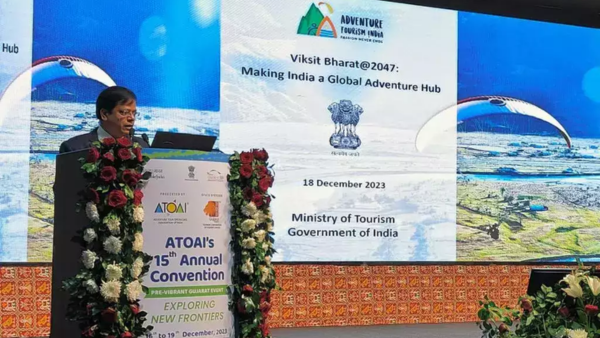
During the ATOAI Convention held in Ekta Nagar, the Ministry of Tourism launched the
Adventure Tourism India Website and announced the Best Adventure Tourism Destination
Competition 2024. The event also witnessed various state presentations as well as the
strategies taken into action for adventure tourism. Emphasis was placed on capacity building
marketing, promotion and the necessity of collaboration among central, state, and industry
stakeholders.
The Ministry of Tourism convened the National Conference on
Adventure Tourism, held from December 18 to 19, 2023 in Ekta Nagar,
Gujarat. Based on the theme, ‘Viksit Bharat@2047: Making India a
Global Adventure Tourism Hub’, the primary objective revolved around
creating a platform for in-depth discussions and formulating strategies to
propel India into a prominent role as a global adventure tourism
destination.
Fueled by ambition, the Ministry of Tourism aims to achieve a robust
USD 3 trillion tourism economy by 2047, with a substantial contribution
of USD 800 billion from adventure tourism alone. This vision also
encompasses elevating India into the top ten adventure tourism destinations globally.
To materialise this goal, the agenda includes attracting 20 million
Foreign Tourist Arrivals (FTAs) and 80 million Foreign Tourist Visits
(FTVs) specifically for adventure tourism, generating a significant
foreign exchange of USD 90 billion. Domestic visits are expected to
reach 4 billion for adventure tourism within the country. Such an ascent
from the 96th to the 10th position globally necessitates a cohesive
strategic roadmap jointly designed by the Central Government in
collaboration with States and Industry stakeholders.
India's geographic diversity stands as a substantial advantage, boasting
rich natural and eco-tourism resources. The country boasts 70 percent of
the Himalayas, a 7,000-kilometer coastline, both hot and cold deserts,
extensive forest cover (ranking 10th globally), and a remarkable count of
recognized UNESCO Natural Heritage sites. Furthermore, India hosts
an array of iconic wildlife species, including tigers, lions, elephants,
rhinos, leopards, and more than 1200 species of birds.
To materialise this goal, the agenda includes attracting 20 million
Foreign Tourist Arrivals (FTAs) and 80 million Foreign Tourist Visits
(FTVs) specifically for adventure tourism, generating a significant
foreign exchange of USD 90 billion. Domestic visits are expected to
reach 4 billion for adventure tourism within the country. Such an ascent
from the 96th to the 10th position globally necessitates a cohesive
strategic roadmap jointly designed by the Central Government in
collaboration with States and Industry stakeholders.
India's geographic diversity stands as a substantial advantage, boasting
rich natural and eco-tourism resources. The country boasts 70 percent of
the Himalayas, a 7,000-kilometer coastline, both hot and cold deserts,
extensive forest cover (ranking 10th globally), and a remarkable count of
recognized UNESCO Natural Heritage sites. Furthermore, India hosts
an array of iconic wildlife species, including tigers, lions, elephants,
rhinos, leopards, and more than 1200 species of birds.To materialise this goal, the agenda includes attracting 20 million
Foreign Tourist Arrivals (FTAs) and 80 million Foreign Tourist Visits
(FTVs) specifically for adventure tourism, generating a significant
foreign exchange of USD 90 billion. Domestic visits are expected to
reach 4 billion for adventure tourism within the country. Such an ascent
from the 96th to the 10th position globally necessitates a cohesive
strategic roadmap jointly designed by the Central Government in
collaboration with States and Industry stakeholders.
India's geographic diversity stands as a substantial advantage, boasting
rich natural and eco-tourism resources. The country boasts 70 percent of
the Himalayas, a 7,000-kilometer coastline, both hot and cold deserts,
extensive forest cover (ranking 10th globally), and a remarkable count of
recognized UNESCO Natural Heritage sites. Furthermore, India hosts
an array of iconic wildlife species, including tigers, lions, elephants,
rhinos, leopards, and more than 1200 species of birds.
To materialise this goal, the agenda includes attracting 20 million
Foreign Tourist Arrivals (FTAs) and 80 million Foreign Tourist Visits
(FTVs) specifically for adventure tourism, generating a significant
foreign exchange of USD 90 billion. Domestic visits are expected to
reach 4 billion for adventure tourism within the country. Such an ascent
from the 96th to the 10th position globally necessitates a cohesive
strategic roadmap jointly designed by the Central Government in
collaboration with States and Industry stakeholders.
India's geographic diversity stands as a substantial advantage, boasting
rich natural and eco-tourism resources. The country boasts 70 percent of
the Himalayas, a 7,000-kilometer coastline, both hot and cold deserts,
extensive forest cover (ranking 10th globally), and a remarkable count of
recognized UNESCO Natural Heritage sites. Furthermore, India hosts
an array of iconic wildlife species, including tigers, lions, elephants,
rhinos, leopards, and more than 1200 species of birds.
To materialise this goal, the agenda includes attracting 20 million
Foreign Tourist Arrivals (FTAs) and 80 million Foreign Tourist Visits
(FTVs) specifically for adventure tourism, generating a significant
foreign exchange of USD 90 billion. Domestic visits are expected to
reach 4 billion for adventure tourism within the country. Such an ascent
from the 96th to the 10th position globally necessitates a cohesive
strategic roadmap jointly designed by the Central Government in
collaboration with States and Industry stakeholders.
India's geographic diversity stands as a substantial advantage, boasting
rich natural and eco-tourism resources. The country boasts 70 percent of
the Himalayas, a 7,000-kilometer coastline, both hot and cold deserts,
extensive forest cover (ranking 10th globally), and a remarkable count of
recognized UNESCO Natural Heritage sites. Furthermore, India hosts
an array of iconic wildlife species, including tigers, lions, elephants,
rhinos, leopards, and more than 1200 species of birds.
Despite this wealth of natural resources and potential, India currently
holds a comparatively low position in the global adventure tourism
sphere. Recognising the country's immense potential to emerge as a
global adventure tourism marketplace, efforts are being directed toward
attracting adventure enthusiasts from around the world.
To give impetus to adventure tourism's development, the Ministry of
Tourism has laid out a comprehensive National Strategy. The Indian
Institute of Travel and Tourism Management has been designated as the
Central Nodal Agency for Adventure Tourism, providing crucial
technical support. Additionally, the establishment of a National Board
for Adventure Tourism, comprising representatives from Central
Ministries, States, and Industry Stakeholders, aims to provide guidance
for sectoral development.
Strategic pillars have been identified to foster sustainable tourism,
adventure tourism, and ecotourism, including state assessments and
strategies, capacity building, marketing and promotion, safety
management frameworks, rescue grids, destination and product
development, and governance frameworks.
During the conference, the Ministry of Tourism launched the 'Adventure
Tourism India Website' and announced the 'Best Adventure Tourism
Destination Competition 2024'.
The event also witnessed various presentations, including the National
Strategy for Adventure Tourism by Additional Secretary (Tourism)
Rakesh Kumar Verma. Emphasis was placed on capacity building,
marketing, promotion, and the necessity of collaboration among central,
state, and industry stakeholders.
Notable international and industry perspectives were shared by Mike
Druce, Coach at Slalomcoach, and Ajeet Bajaj, President ATOAI,
respectively.
The conference also dedicated a session to 'Propelling States for
Adventure Tourism', featuring presentations from various states
showcasing their adventure tourism assets, development initiatives, skill
building efforts, marketing strategies, safety measures, and alignment
with national policies and digital platforms.
On the subsequent day, the focus shifted to 'Destination Planning,
Development, and Management', sharing best practices and experiences.
Case studies on developing Ekta Nagar as a green field tourism
destination and creating a sustainable and responsible tourist destination
under Swadesh Darshan 2.0 were spotlighted.
The final session provided updates on various initiatives of the Ministry
of Tourism, encompassing the Incredible India Portal, Meet in India
campaign, Wed in India campaign, Travel for LiFE Campaign, Travel for
LiFE: Tourism for Tomorrow Competition, Best Tourism Village, and
Best Rural Homestays Competition.
The state representatives including Sachin Kurve, Secretary,
Uttarakhand Tourism Development Board (UTDB); Swapnil Naik,
Secretary (Tourism), Arunachal Pradesh; Hareet Shukla, Secretary
(Tourism), Gujarat; Kaushlendra Vikram Singh IAS, MD MP Tourism
corporation; Kunzes Angmo, Director (Tourism), UT Ladakh; P.B. Nooh,
Director (Tourism), Kerala; C.S.Rao, Principal Secretary, Sikkim Tourism
and Rakhee Gupta Bhandari, Pr. Secretary, Punjab made the
presentations during the conference.
Director Niche Tourism, Radha Katyal Narang, commended the State
Government of Gujarat and the Adventure Tour Operator Association of
India (ATOAI) for the success of the 15th Annual Convention & PreVibrant Gujarat Event, emphasising the Ministry's ongoing efforts in
promoting and developing sustainable adventure tourism in the country.