
Uttarakhand reopens for tourism
- Jul 09,2020
- Hotelier India
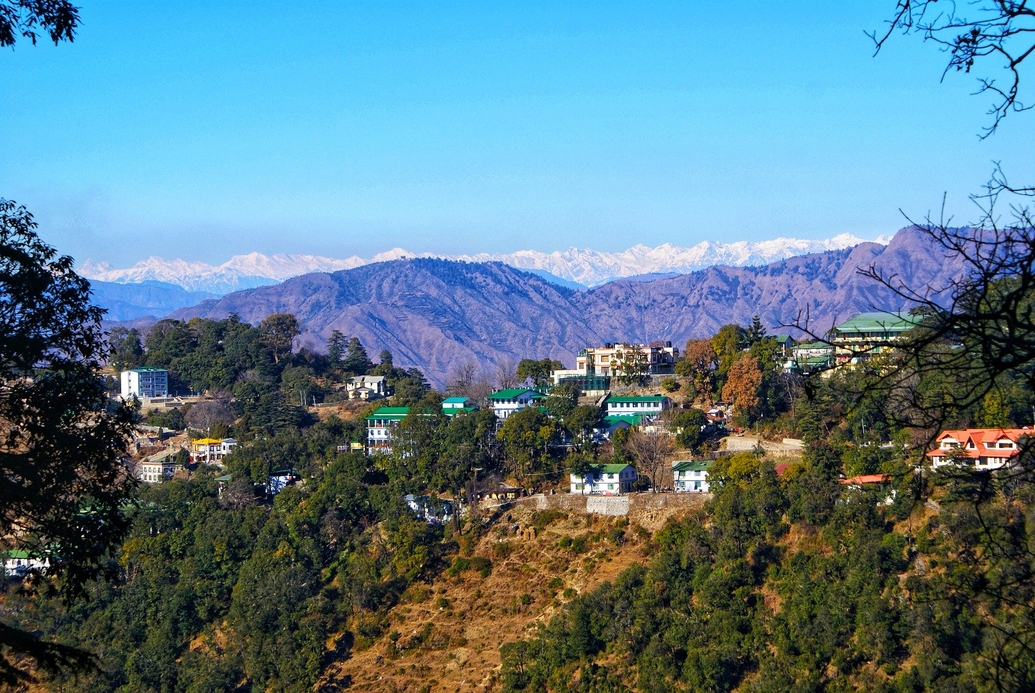
Tourists coming from other states to Uttarakhand will be able to tour the state without being quarantined and with reports of Covid-19 being negative. The Uttarakhand government has allowed reopening of its borders ( inter-state and inter-district) for tourism acitvities. Now, tourists coming from other states to Uttarakhand will be able to tour the state without being quarantined and with reports of Covid-19 being negative. However, the Char Dham Yatra will currently be available only to the residents of Uttarakhand. Tourism Minister Shri Satpal Maharaj said "Tourists from other states are welcome in Uttarakhand's Devbhoomi. Hopefully every tourist will enter the state with Covid-19 negative test report and enjoy the beautiful tourist places of Uttarakhand. The threat of any kind of infection in the state will be prohibited and the tourism business of the state will gain new momentum. People working in the tourism sector will get employment again. " Uttarakhand Tourism Secretary, Dilip Jawalkar informed that all tourists coming from other states of the country will have to upload the report related to Covid-19 test on the portal of Smart City Dehradun at the time of registration and also they must necessarily do this while traveling in the state and have to take the report along with them. Tourists who have not been given the Covid-19 test will be able to enter the state in the event of a minimum seven-day hotel booking and after 7 days they will be able to visit any place in the state. They will be able to stay in the hotel premises for the first seven days. Hotels will also have to ensure that guests booking less than 7 days have received RT-PCR test from ICMR authorized laboratory in the last 72 hours and their Covid-19 test is found to be negative. Inter-state tourists will be allowed to travel anywhere in the state, but for this they will have to be compulsorily registered on the smart city portal. Giving details about the new guidelines Jawalkar said “Guests coming from Uttarakhand and other states to attend the wedding ceremony will not have to be quarantined although it will be conditioned that apart from the place of marriage will not be able to visit places. All of them have to sign and submit a self-declaration form. The hotel or the banquet hall organizing the wedding ceremony will inform the local administration in this regard and will ensure thermal screening and social distancing. Also, they have to compulsorily create a database of their employees and visitors."
Read more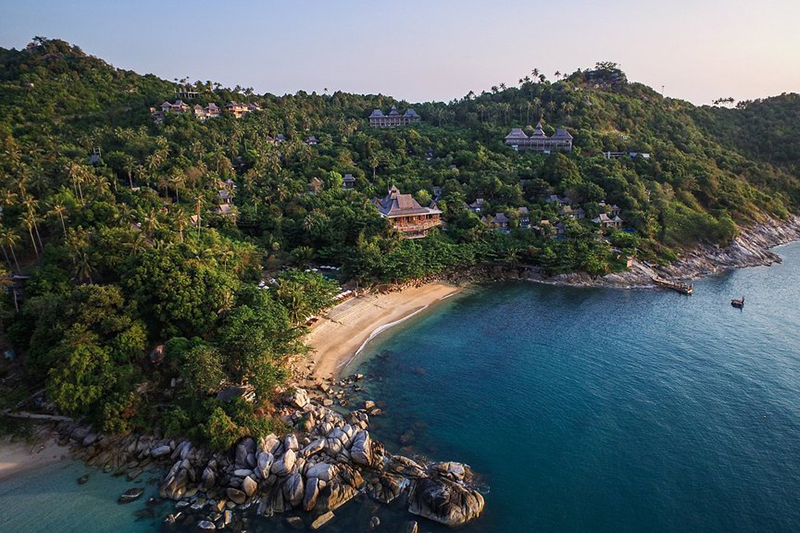
Thailand Launches “Buy Now, Stay Later” Promo
- Jul 09,2020
- Travel Agent Central
The Tourism Authority of Thailand (TAT) has announced the launch of “Buy Now, Stay Later: Thailand,” in response to the impact of COVID-19 on the country’s tourism industry. As Thailand’s restrictions on foreign tourists entering without exemptions have been extended until further notice, the promotion offers travelers a way to plan and save money on future trips through the purchase of hotel bonds that increase in value over time. The launch of the campaign follows TAT’s announcement of the country’s multiphase reopening to foreign tourists, slated to potentially begin on August 1, 2020. Thailand’s reopening will tentatively begin in the geographically secluded provinces of Phuket, Krabi and Surat Thani, where health monitoring can be more easily controlled. Many of the “Buy Now, Stay Later: Thailand” hotels are located in the first provinces slated to reopen. Through the website, travelers can access a list of partner properties and connect with them directly to purchase bonds in $100 increments. Similar to savings bonds, hotel bonds purchased for $100 today can be redeemed for a value of $150 following a 60-plus day maturation period. Partner properties include Anantara Mai Khao Phuket Villas, The Slate Phuket, Santhiya Koh Phangan Resort & Spa and Rocky's Boutique Resort Koh Samui, among others. The director of TAT, Vachirachai Sirisumpan, said in an announcement, “With the launch of ‘Buy Now, Stay Later: Thailand,’ TAT is broadening the systems of support we have in place for Thailand’s hotels. We hope that this revenue-generating initiative will help to ensure the survival of many of the country’s most beloved tourist destinations. Furthermore, we hope the campaign inspires and empowers foreign visitors to invest in the tourism industry in Thailand.” “Buy Now, Stay Later: Thailand” is a part of the “Buy Now, Stay Later” program developed by Rachel Harrison of Lion & Lamb Communications. Created in April 2020 as an early response to the impact of COVID-19 on the hotel industry, “Buy, Now, Stay Later” has since expanded to include 500-plus partner properties in countries around the world. Many participating hotels have reported an uptick in bookings as a result of guests connected through the website.
Read more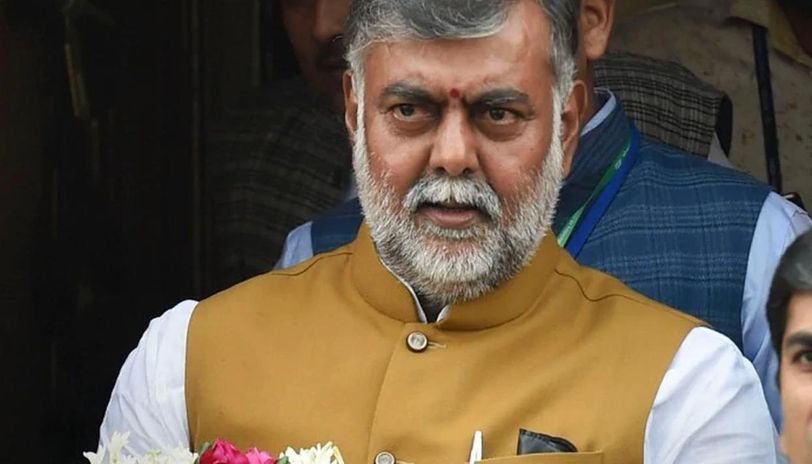
Tourism Minister Stresses Need To Reopen More Monuments
- Jul 09,2020
- Republic World
After a shutdown of more than 100 days, all architectural monuments protected by the Archaeological Survey of India (ASI) were opened, as announced by the Ministry of Culture. While only 820 monuments were allowed to be reopened from June 6, Union Minister for Tourism and Culture Prahlad Singh Patel said that more heritage sites should be opened in consultation with the state governments and in accordance with Coronavirus precautions. "Around 800 monuments including Taj Mahal remain closed but we have to resume work soon," he said. On July 2, Prahlad Patel announced that all ASI-protected Indian monuments would be open to the public during the Unlock 2.0 phase. Due to the Covid-19 lockdown, over 3000 ASI monuments had been closed for visitors from March 17, 2020. However, 820 monuments were allowed to reopen on June 6. People will be allowed to visit the monuments only if they abide by the Covid-19 precautions and maintain social distancing. While all national monuments open up for the public, Agra's historical monuments like Taj Mahal, Agra Fort, Akbar tomb and others will continue to remain closed until further orders. According to District Magistrate of Agra, Prabhu N Singh, these monuments fall in 'buffer zone' areas; hence, it will not be opened to the public despite being closed for three months. SOP & Guidelines According to the SOP issued by the Centre, only those monuments and museums which are in the non-containment zone will be allowed to open up. Along with this, the administration is also doing away with the physical sale of tickets, all tickets will be issued through e-mode only. Even the mode of payment in the parking lots, cafeterias would be accepted only digitally. There will also be a cap on the number of visitors in the monuments, along with strict compliance of social distancing, use of masks, hand hygiene, thermal scanning etc. All special sound and light shows will be suspended in the monuments and group photography will also remain suspended. Meanwhile, eatables inside the monuments will not be allowed and cafeterias would also be limited to serving only bottled water inside the premises.
Read more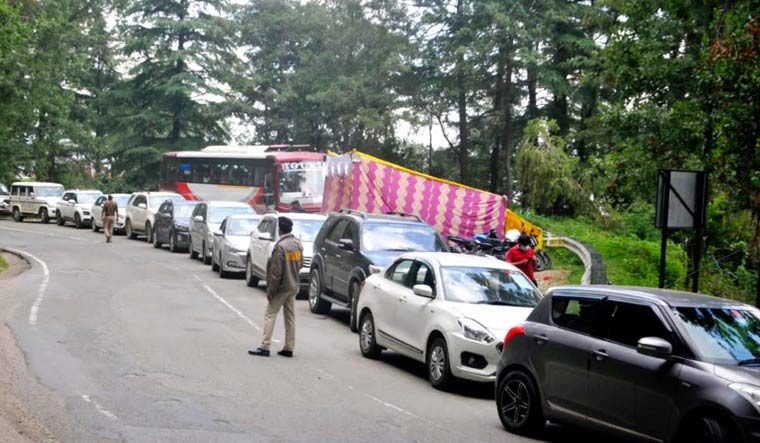
Tourists from Punjab, Delhi, Haryana reach Shimla after the reopening of HP
- Jul 08,2020
- The Week
The Himachal Pradesh government's decision to relax e-pass norms for tourists and natives entering the state has led to chaos in the state capital Shimla. The entry of tourists in Himachal Pradesh was banned in March to check spread of novel coronavirus. Hundreds of people queued up at the Shimla border check point near Shoghi. As a majority of these had no valid documents, the district authorities turned many away while home quarantining local residents returning from other states. According to officials, despite clear instructions mandating COVID-19 negative certificate or reports of tests conducted not later than 72 hours and pre-booking of hotels for at least five days, majority of the tourists had none of these. When asked to go back, many disobeyed social distancing regulations and got into heated arguments with cops and district administration officials. It was only when local authorities started registering FIRs that the tourists retreated. The local residents, meanwhile, are up against the decision to allow tourists to Himachal and have warned of aggressive protests. "Haryana, Punjab and Delhi have high COVID-19 numbers and letting people in from there will put us all at risk. We will not allow tourists here and will seal our city ourselves, " said Suresh Kashyap, a local activist. The hoteliers too have communicated their apprehension about opening up. "We are just getting one or two bookings, and that too without COVID negative certificate. We cannot afford to pay staff, run facility or kitchens and be at risk of COVID. We cannot open," said Kullu Hotel association. The tourism department had, on Saturday, issued a standard operating procedure (SOP) with which the tourists are allowed to enter Himachal with conditions such as a report by an ICMR-accredited laboratory not earlier than 72 hours, testing negative for COVID-19 and a prior hotel booking of at least five days. Such tourists will also have to register online with the state government before entering the state, the state tourism director Yunus Khan had said.
Read more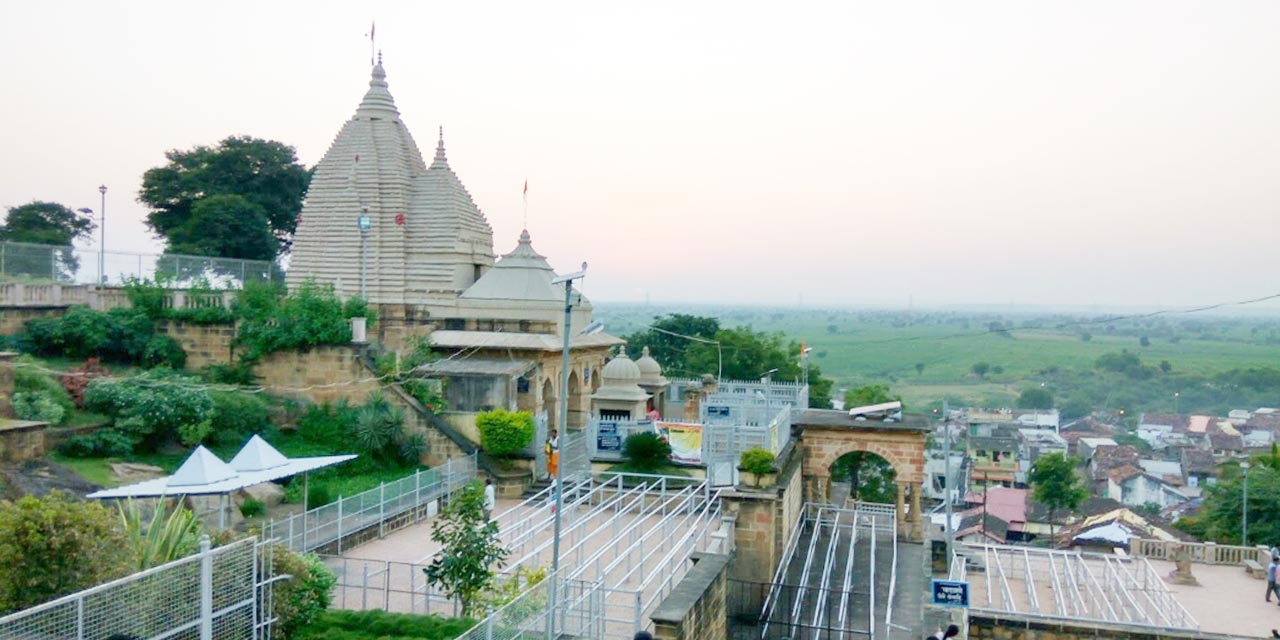
Eco-tourism park planned at Adasa
- Jul 08,2020
- Times of India
The Nagpur forest division is implementing an ambitious Rs5-crore eco-tourism project in temple town of Adasa, 40km from here. The project is expected to open in six months. The project will have a big interpretation centre (Rs1.50 crore), nature trails and park, watch towers, adventure park (Rs1.50 crore) with attractions like vertical ejection tower, zip line, skywalk, wall climbing, and zorbing ball. Entry fee has been tentatively fixed at Rs20 and Rs10. “The project will be run by local joint forest management committee (JFMC) on the lines of Hazara Falls, a tourist attraction in Salekasa in Gondia district,” said deputy conservator of forest (DyCF) Prabhunath Shukla. “Major attraction will be an interpretation centre to be developed by Centre for Environment Education (CEE), an institution working under MoEFCC to enhance environment education. It will revolve round elephants and Lord Ganesha,” said Shukla. The forest department on Monday took up plantation drive by Sunil Kedar, minister of animal husbandry, dairy development, sports and youth welfare, at Adasa. Shukla said the proposed plantations are based on ‘Panchavati’ theme in Nashik wherein trees banyan, peepal, gular (fig), bel and amla together will be planted. These plantations will be under drip irrigation and proposed to have chain-link fencing along with having nature trail, sitting zone etc. A machan is proposed in the park from where visitors can get a glimpse of Lord Ganesha situated in the ‘garbhgriha’ directly. The biodiversity park is one of the components of Adasa eco-tourism plan. Nature interpretation centre has been completed during 2017. Last year, the work of exhibits in nature interpretation costing Rs1.50 core has received administrative sanction under district plan. The interpretation centre will have six rooms dedicated to introduction, behaviour, habitat, distribution of elephant and its conservation issues. The work of exhibits is being planned to be executed through CEE, Ahmedabad. Adasa temple will be connected with biodiversity park. The objective of this project is to provide an alternative tourism site near Nagpur to develop the area as nature education centre and generating livelihood for the local committee.
Read more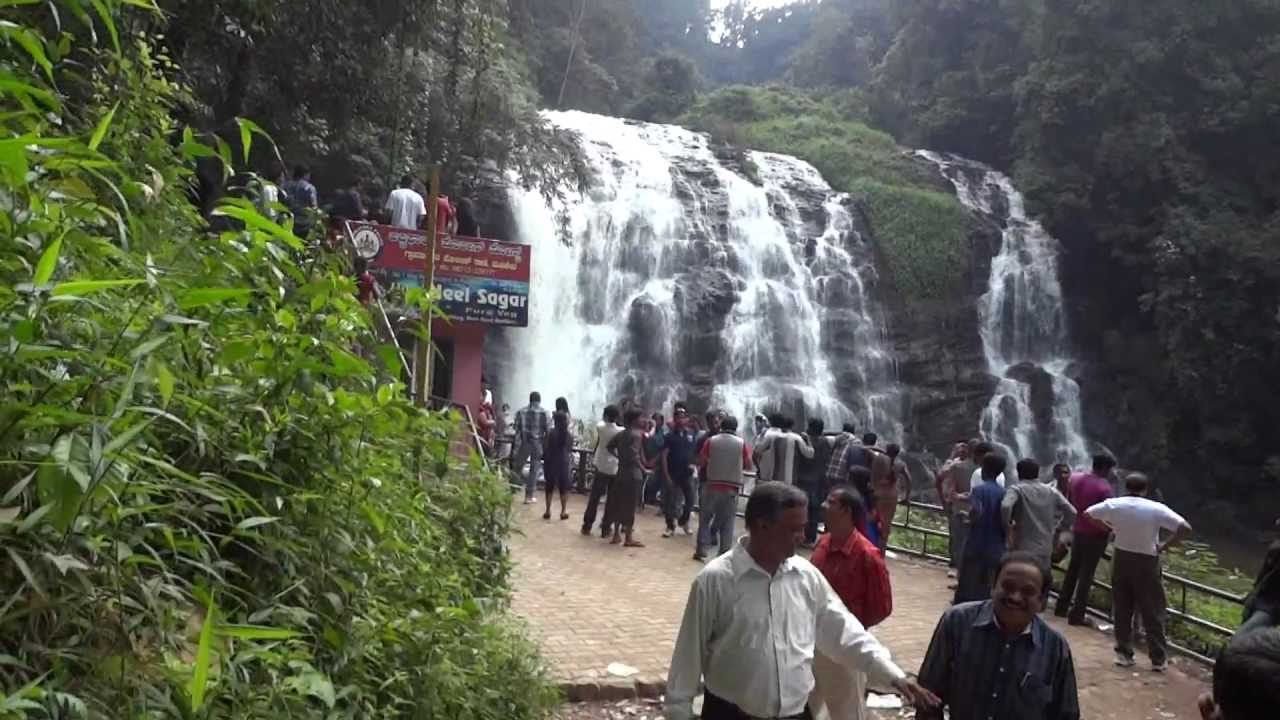
Fearing covid, Kodagu orders closure of tourist accommodation in district
- Jul 08,2020
- Live Mint
The Kodagu administration on Tuesday ordered the closure of all resorts, hotels, and homestays in the district to discourage tourists from flocking to this coffee-growing region popularly known as Coorg, in view of a rise in covid-19 cases in Karnataka. With a sharp surge in cases reported from across the state, the directive appears to be a prelude to the possibility of reimposition of restrictions on inter-district movement. In a notification, Kodagu Deputy Commissioner Annies Kanmani Joy has ordered resorts, hotels, and homestays against accepting reservations from people outside the district, state, or country. The order comes a day after the Kodagu reported its first covid-19–related fatality. It now accounts for 78 of the 25,317 cases recorded across Karnataka. Kodagu, about 225 km from Bengaluru, saw a surge in cases along with the rest of Karnataka forcing authorities to clamp down on certain relaxations that allows free movement of people. "The restriction has been put into place over the insistence of locals and association of hospitality operators," C. T. Ravi, Karnataka's minister for tourism. He said the district administration would have taken the decision based on the situation there. Operators of resorts and homestays had earlier appealed to the government to allow partial reopening of services, to help these establishments sustain themselves and make up for piling losses due to the three months of covid-19–induced lockdown. They had even started promoting 'workations', which refers to a form of tourism where people would work while on holiday. This was expected to help bring in some business. Ravi, the tourism minister, said such tourism, though, could trigger a clash between locals and tourists over the fear of spread of covid. He, however, denied the possibility of banning inter-district movement, at least for the time being. The lifting of inter-district movement saw tourists flocking to resorts close to Bengaluru such as those in Chikkamagaluru and Kodagu. But people with travel history to Bengaluru have tested positive in other districts, sparking fears that residents of India's technology capital may be carrying and spreading the virus. Chikkamagaluru, another coffee-growing destination about 250 km from Bengaluru, had also restricted tourists after videos of locals waylaying tourists went viral on social media. Ravi said even operators of resorts and homestays made a plea to the district administration to place a temporary ban on tourists to help contain the possibility of the spread of coronavirus.
Read more