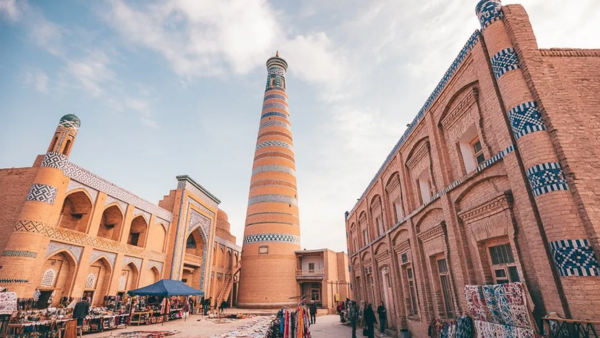
In the small town of Khiva in Uzbekistan, bounded by the Karakum and Kyzylkum deserts, all roads lead to a walled fortress known as Itchan Kala. That's because everything that's worth seeing and experiencing in Khiva is contained within the walls of this citadel. It's home to more than 60 cultural sites, medieval mosques and opulent palaces, as well as numerous museums, souvenir shops and craft studios.
The Itchan Kala is where I was headed bright and early one autumn morning. Entering from the Ota Darwza, or the West Gate, located close to the ticket counter, I could see the street shops slowly coming to life: the chugirma vendor was fluffing up his collection of sheepskin fur hats used by locals to keep their heads warm in the bitter winters; the woman selling traditional ikat-print chapans (long coats) lured me with a striking black-and-white jacket; the master woodcarver was sitting on his chair, head bent over what looked like an intricately chiselled cheeseboard; the carpet weaver briefly looked up from the loom to smile at me before bending her head back to study the pattern.
But the roads were strangely empty. Where were all the tourists?
Along with Bukhara and Samarkand, Khiva – locally pronounced "Heevah" – forms Uzbekistan's troika of Silk Road cities. But only the two former have become popular among tourists, due to their proximity to the capital city of Tashkent. Just a mention of those names is enough to evoke images of a time when these cities were at the heart of the influential network of trading routes stretching from China all the way to Rome and Venice. For much of those 1,500 years, roughly from 130 BCE until 1453 CE, this central Asian region saw the exchange of not just silks and spices, but all kinds of ideas and philosophies.
While most of the old monuments inside the Itchan Kala have been restored to their former glory, the former madrasahs (Islamic schools) have been repurposed into craft workshops or souvenir markets. Whenever I stopped to look, admire or just take photos, I noticed no irritation among the vendors; there was no hard-sell, no aggression. Everything somehow seemed slower here, everyone calmer. I found myself mentally discarding the must-see list I had made earlier, and I surrendered myself to serendipity.
As Sethi Ramakrishna said, "There is no pressure here like in the larger towns – you can take your time and sit down to sip an Uzbek lemon tea, and see the vendors making their sales and young couples having a photoshoot. And wonder how the caravans of yore found their way to this beautiful place on the Silk route."
I followed her lead and settled down for some people-watching at an al fresco choyxona (teahouse) just opposite Kalta Minor. The Silk Road itself may be a thing of the past, its relevance wiped away by the advent of more convenient sea routes. But sitting here in a corner of Khiva, I knew for sure that its legacy lives on.
Read more