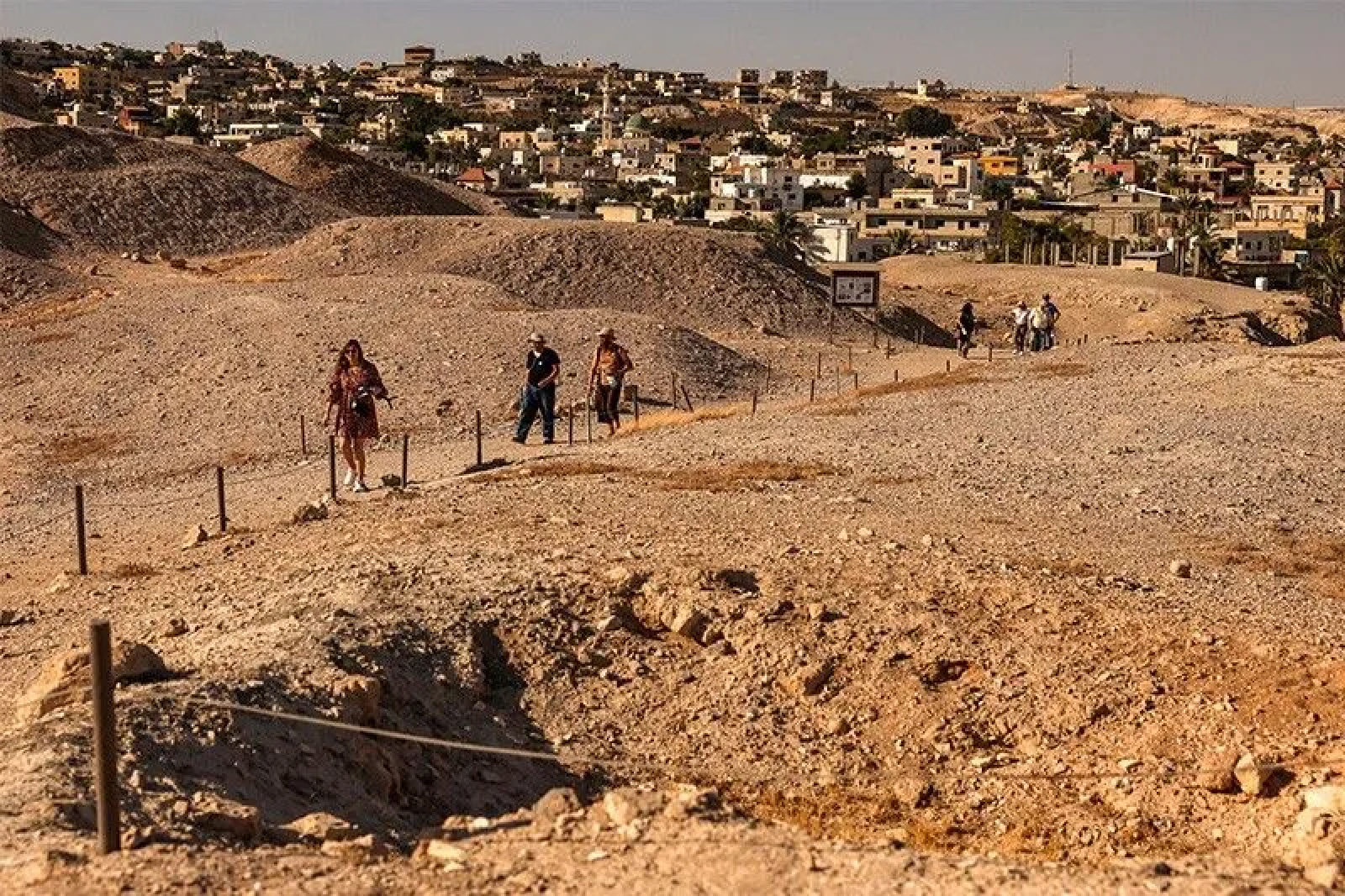
UNESCO adds Palestinian prehistoric Tell al-Sultan site to world heritage list

Tell al-Sultan, an oval-shaped mound in Jordan Valley which predates Egypt's pyramids, is 4th Palestinian site to be listed on UNESCO's world heritage list UNESCO inscribed the prehistoric site of Tell al-Sultan, near the Palestinian city of Jericho in the occupied West Bank, on its World Heritage List Sunday, in a move criticized by Israel. Tell al-Sultan, which predates Egypt's pyramids, is an oval-shaped tell, or mound, in the Jordan Valley, and contains the prehistoric deposits of human activity. The decision by the United Nations cultural organization, which it posted on X, formerly Twitter, was taken at its 45th world heritage committee meeting held in Riyadh. "The property proposed for nomination is the prehistoric archaeological site of Tell al-Sultan, located outside the antique site of Jericho," UNESCO's assistant director general, Ernesto Ottone, said at the session. The site was inscribed following a three-year candidacy "during which no state party raised any objections", said a diplomat, speaking on condition of anonymity as he was not authorized to speak to the media. "There are no Jewish or Christian remains found at the (Tell al-Sultan) site. It's a place of pre-historic remains," the diplomat told AFP. Israel denounced the decision. "The foreign ministry considers today's decision another sign of the cynical use the Palestinians are making of UNESCO and the organization's politicization," a ministry statement said. "Israel will act with its many friends in the organization to change the flawed decisions made." Israel quit the UN organization in 2019 over accusations that it fosters an anti-Israel bias, but did send a delegation to this year's meeting in Saudi Arabia. The Palestinian Authority, acknowledged by the United Nations as a non-member observer state, welcomed the listing of Tell al-Sultan site. Palestinian president Mahmud Abbas said he considered the decision "a matter of great importance and evidence of the authenticity and history of the Palestinian people". He vowed that the Palestinian authorities would "continue to preserve this unique site for all humanity", a statement from his office said. UNESCO's listing shows that the site is "an integral part of the diverse Palestinian heritage of exceptional human value", Palestinian tourism minister Rula Maayah, who was at the meeting in Riyadh, said in a statement. Given Tell al-Sultan's "importance as the oldest fortified city in the world... it deserves to be a World Heritage Site", she said. "A permanent settlement had emerged here by the 9th to 8th millennium BC due to the fertile soil of the oasis and easy access to water," UNESCO said on its website. It said the "skulls and statues found on the site" testify to cultic practices among the Neolithic population there, while the early Bronze Age archaeological material shows signs of urban planning. "Vestiges from the middle bronze age reveal the presence of a large Canaanite city-state occupied by a socially complex population," UNESCO added. The site has been under excavation for more than a century and is billed as the oldest continuously inhabited settlement on the planet, Palestinian official Wafa news agency reported. It is the fourth Palestinian site to be listed on UNESCO's world heritage list, alongside the Church of the Nativity and the Old City of Hebron. Israel has occupied the West Bank -- now home to some three million Palestinians -- since the 1967 Six-Day War, when it also seized the Gaza Strip, the densely populated coastal enclave from which it withdrew in 2005. The Palestinians want both territories for their future state, along with annexed east Jerusalem as its capital. Jericho is one of the oldest inhabited cities on the planet and a major tourist destination in the Palestinian territories. UNESCO also urged that other archaeological sites in Jericho be protected. "The other archaeological sites located in Jericho, covering among other Jewish and Christian heritage, also have important historical interest and deserve to be preserved as well," Ottone said. Archaeology is a highly political subject in Israel and the Palestinian territories, and discoveries have been used to justify territorial claims.

Read more

Singapore aims for passport-free departures from Changi Airport next year

According to the changes to the city-state’s immigration law, passengers will be able to depart from Singapore’s Changi Airport without a passport soon. Some passengers will soon be able to depart from Singapore’s Changi Airport without a passport, as part of changes to the city-state’s immigration law that allows for end-to-end biometric clearance. Singapore aims for passport-free departures from Changi Airport next year(REUTERS) Singapore aims for passport-free departures from Changi Airport next year(REUTERS) From the first half of 2024, biometrics will be used for authentication at various automated steps in the departure process, from bag-drop to immigration and boarding, communications minister Josephine Teo said in parliament Monday. “This will reduce the need for passengers to repeatedly present their travel documents at these touchpoints, allowing for more seamless and convenient processing,” Teo said. The changes come as the number of travelers to the financial hub is expected to rebound to pre-pandemic levels by next year, and continue to increase thereafter. Singapore is currently building its fifth airport terminal, while its high-speed rail linkage with Malaysia’s southern state of Johor is expected to be ready in a few years. “Our immigration systems must be able to manage this high and growing volume of travelers efficiently and provide a positive clearance experience, while ensuring our security,” Teo said. Ranked the best airport in the world, Changi handled 5.12 million passengers in June, crossing the five million mark for the first time since January 2020 when the pandemic hit. The figure, amounting to 88% of passenger traffic in June 2019, shows the city-state is well on its way to renewing international ties.

Read more

UK increases visa fee for visitors; new rule to be effective from October 4

In a recent update, the Government of Britain has announced that a visa hike will go into effect on October 4. The new fee structure, a visit visa for a stay of less than six months will cost GBP 15 (INR 1544) more while student visas will see a GBP 127 (INR 13,080) increase for travelers across the globe, including India. The news of these changes was confirmed this Friday by the UK Home Office through legislation in Parliament on Friday. It will result in the cost of a visit visa for less than six months rising to GBP 115 (INR 11,845). British Prime Minister Rishi Sunak in July had announced that there would be a hike in visa fees and health surcharges. He had said that they will increase the charges that they have for migrants who are coming to the UK when they apply for visas and indeed something called the Immigration Health Surcharge (IHS). All the fees are going to go up and that will raise over GBP 1 billion. The Home Office has said a 15% hike in the cost of most work and visit visas and an increase of at least 20% in the cost of priority visas, study visas, and certificates of sponsorship. The Home Office said this week, “Income from fees charged plays a vital role in the Home Office's ability to run a sustainable immigration and nationality system. Careful consideration is given when setting fees to help reduce the funding contribution from British taxpayers, whilst continuing to provide a service that remains attractive to those wishing to work in the UK and support broader prosperity for all”. The fee hike applies across most visa categories. It includes health and care visas, applications to register and naturalize as a British citizen, fees for visas of varying durations (up to six months, two, five, and ten years), along with fees for entry clearance.

Read more

Work on Dwarka expressway tunnel connecting Haryana border to IGI Airport 80% complete: NHAI officials

Work on the tunnel connecting Kapashera border to NH-8, which is being constructed to facilitate seamless connectivity from the Haryana border to the IGI Airport in Delhi, is around 80 per cent complete, NHAI officials said Saturday. The tunnel is a part of the Dwarka Expressway, a key project of the National Highways Authority of India (NHAI). With a length of 3.6 km and eight lanes, the tunnel is touted to be the longest and widest urban road tunnel in the country. According to NHAI officials, the tunnel is one of the two tunnels that are part of package 1 of Dwarka Expressway. The other tunnel, from NH-8 to terminal 3 of the airport, is 2.5km long, officials said, adding 50 per cent of the work on the structure has been completed. The second tunnel will have six lanes, said sources. Don't miss | Rs 18 crore per km to Rs 250 crore per km, CAG flags ‘very high’ project cost of Dwarka Expressway “Anyone coming from Panipat can take the Urban Extension Road-2 (UER 2) upon reaching Alipur, continue till Dwarka Expressway, which is around 40 km away from Alipur, and take the tunnel to reach the airport,” said officials. The UER 2, connecting Alipur in north Delhi with Delhi-Jaipur highway, near Rajokri in southwest Delhi, will be inaugurated by the end of this year and unclog several parts of the national Capital, Union Minister of Road Transport and Highways Nitin Gadkari had said earlier this year. Temporary solution to congestion in capital: Expert “The tunnel is aimed at reducing traffic congestion in the city, and the time it takes to get to the IGI from inside the city will be reduced. However, this is a temporary solution to the congestion in the capital. The higher the supply, the more the demand, and vehicular density is only going to increase,” said Amit Bhatt, managing director for India at the International Council on Clean Transportation. Project comprises four levels The Dwarka Expressway project consists of four levels: Tunnel/Underpasses, At-Grade Road, Elevated Flyover, and Flyover above Flyover. According to NHAI officials, after the completion of the construction on the tunnel and the UER 2, the distance between Manesar in Gurgaon to IGI is expected to reduce to 20 minutes.

Read more

Rajasthan To Unlock Tourism Potential Of Lesser-Known Destinations

The Rajasthan government is all set to unlock the tourism potential of lesser-known places as it has identified two sites in selected districts for their development as new tourism sites. The sites are being developed in various districts, including Alwar, Ajmer, Bhilwara, Bundi, Bharatpur, Banswara, Dausa, Dungarpur, Jodhpur, Jhalawar, Jalore, Jhunjhunu, Karauli, Nagaur, Sirohi, Bikaner, Chittorgarh, Hanumangarh, Jaisalmer, Jaipur, at a cost of INR 70.06 crore. An official said the move will transform the tourism landscape of the state which offers a range of tourism sites, from desert to hill station. “Two tourist destinations have been identified in districts and development work has started through the Tourism Development Fund,” Gayatri Rathore, Principal Secretary, Tourism, said. She said new tourist places will be developed and the benefits of the tourism industry will be available district-wise in the state. Director of the Tourism Department, Rashmi Sharma said work is going on at a fast pace to promote tourism in the state. “The tourism department is working in coordination with other government departments like forest, archaeology and Public Works Department for the development of tourism sites,” she said. “Rajasthan is not just about forts and places, many more sites are there in the state which has great potential to be developed as tourist attractions,” another official said. There has been a record arrival of tourists on extended weekends and New Year, particularly in Jaipur, Udaipur and Jaisalmer which has necessitated development of facilities for tourists, Gaurav Bhatt, a tourist guide, said. In August, Udaipur witnessed a record surge in the number of tourists. Deputy Director of the Tourism Department in Udaipur, Shikha Saxena said Udaipur continues to be a top destination, drawing visitors from all over to enjoy its natural beauty and serene lakes. “This year has been quite eventful for Udaipur in terms of tourism. In January, 1,80,000 domestic tourists and 14,215 foreign guests visited,” she said. She also said 1,60,567 tourists flocked to the lake city in the monsoon season. Among them, 1,51,300 were domestic tourists, while 9,267 were foreigners

Read more

How payment tools are shaping travel experiences

India’s tourism sector ranks among the fastest-growing economic sectors in the country, projected to contribute $250 billion to the country’s GDP by 2030 and serve as an economic catalyst that boosts job creation and development. The burgeoning tourism and increasing payment hassles hamper the quality of the experience whilst impacting the growth of the tourism industry. To address the numerous complexities that foreign tourists face, CheqUPI – India’s first UPI interface platform for foreign nationals has recently conducted a survey to unveil how payment hurdles affect satisfaction rates among tourists and how CheqUPI could be a game-changer for the digital payment landscape in creating immersive experiences. The tourism sector is continuing to grow at an unprecedented momentum. However, tourists face several routine challenges while making payments which can stagnate the bulging growth of this industry. According to the survey, 75% of tourists find cash dependency as one of the significant challenges, while 85% of them feel that finding ATMs, especially in remote areas that accept international cards can be a major inconvenience. A lack of adequate facilities and access to financial tools can severely impact the interests of foreign visitors cultivating a negative impression. On the contrary, employing robust UPI technology can help in streamlining, optimising and enhancing the digital payment expense for foreign nationals ensuring the delivery of a mesmerising journey. By harnessing the power of UPI, tourists can make payments from any corner of the country enjoying their journey not as tourists but like any other Indian citizen. Commenting on the potential of UPI, Manish Shukla, Co-founder, CheqUPI said, “ UPI is all set to revolutionise the digitised financial journey of foreign nationals visiting India by integrating seamless transaction experience with leading-edge technology. With this innovative financial solution, travellers can easily and securely make digital payments at multiple merchant establishments equipped with UPI QR codes across the country taking a step forward to make online payments accessible for everyone.”

Read more