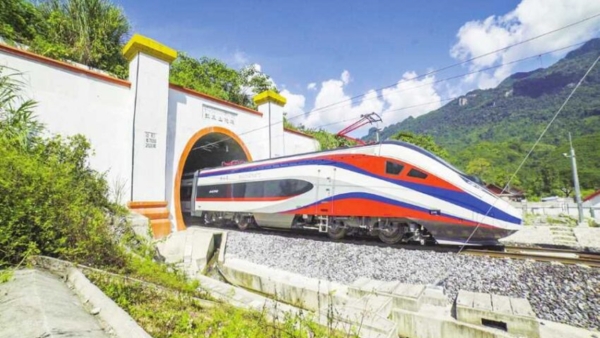
Murree's Glass Train Project to enhance tourism and connectivity by 2025.

The Murree Tourist Glass Train project is gaining significant attention, with its feasibility study for the first phase expected to be completed by April 30, 2025. The project is being regarded as a strategic initiative with the potential to extend further, possibly connecting Murree to Muzaffarabad. The feasibility study, conducted by the National Engineering Services Pakistan (Nespak), is a critical milestone. Upon its approval by relevant authorities, the project will move to the international tendering stage, with plans to implement it through a public-private partnership model. A similar concept was explored during the Kashmir Railway initiative, where the second phase of this project was previously studied. Drawing inspiration from India’s Jammu-Srinagar-Baramulla railway link, the Murree Glass Train aims to enhance connectivity and tourism in the region.

Read more

China’s new visa policy overhaul fuels surge in global travel

The travel trend to China has gained major momentum, largely driven by the country's expanding visa-free policy. From crowded streets in Shanghai to tourists flocking to Chongqing, the surge in foreign visitors has made "China travel" a global phenomenon. As per Qunar, a major Chinese online travel agency, the number of foreign travellers booking domestic flights has nearly tripled compared to 2023, with top travellers from the US, Russia, Canada, South Korea, and Australia. The most notable change is the extension of visa-free stays to five inland provinces—Shanxi, Anhui, Jiangxi, Guizhou, and Hainan—giving tourists more regions to explore. Other provinces like Fujian, Hubei, and Shaanxi also see extended stay areas, allowing tourists to access more parts of the country. The relaxation of China’s visa-free transit policy on December 17 is expected to further boost international tourism. The new policy enables a stay of up to 240 hours (10 days) for eligible travelers, a significant increase from the previous 72 and 144-hour options. This change is anticipated to encourage deeper exploration of China, particularly its lesser-known cities that are rich in cultural heritage. These small and medium-sized cities are predicted to become more popular among travelers seeking to experience authentic Chinese culture away from the crowded tourist hubs.

Read more

Bangladesh’s largest railway opens revolutionizing connectivity

Bangladesh’s largest railway, the Padma Bridge Rail Link Project (PBRLP), officially opened to traffic on Tuesday, marking a historic milestone for the country. The inaugural train, adorned with colorful balloons and ribbons, arrived at Dhaka station to celebrate the occasion. Constructed by China Railway Group Limited (CREC) and funded by the Export-Import Bank of China, the PBRLP is a key project under the Belt and Road Initiative (BRI) in Bangladesh. Spanning approximately 170 kilometers, the railway—locally known as the “Dream Road”—connects the capital Dhaka to the southwestern city of Jashore. The new railway line slashes travel time between Dhaka and Jashore from 10 hours to just three, a game-changer for millions of commuters and businesses.

Read more

Hong Kong To Shenzhen Metro Launch Transforms Travel

The southern segment of Shenzhen Metro Line 13, connecting Nanshan District to the Shenzhen Bay Checkpoint, officially commenced operations on December 28, 2024. This checkpoint is a key hub facilitating travel between Hong Kong and Shenzhen. After a three-month trial phase without passengers, the new line is anticipated to streamline cross-border transit and strengthen ties between the two cities. This fully automated metro line is managed by MTR Corporation in collaboration with MTR Consulting (Shenzhen) Company, China Railway Electrification Bureau (Group) Company, and a Shenzhen municipal government subsidiary. The initial phase spans from Shenzhen Bay Checkpoint Station at the border to Hi-Tech Central Station. Shenzhen Metro Line 13 stretches around 22.4 kilometers, linking Shenzhen Bay Port Station to Gaoxinzhong Station, with 16 stops along the route. During its first phase, operations will be limited to the southern section, serving seven stations with operating hours from 6:30 AM to 11 PM. Once passengers clear the initial checkpoint, they can easily access the metro station for seamless transfers to key destinations such as Luo Hu, Futian, Bao’an, and other areas within mainland China. The metro fare for Line 13 is set at 3 Yuan (approximately HKD 3.19). Uniformed staff are readily available inside and outside the station to assist passengers, while clear signage ensures a hassle-free experience for travelers.

Read more

Guwahati Airport launches new domestic, international routes to Malaysia, and more

Lokpriya Gopinath Bordoloi International Airport (LGBIA), Guwahati, managed by Adani Airport Holdings Limited (AAHL), a subsidiary of Adani Enterprises, the flagship company of the globally diversified Adani Group, has seen a remarkable passenger growth in 2024. With a significant surge in domestic and international travel, the Airport successfully managed an impressive 6.26 million passengers including 3.09 million domestic passenger arrivals and 3.17 million domestic passenger departures. Additionally, LGBI Airport has handled 47,578 international passenger arrivals and 38,528 international passenger departures). GIAL also achieved a remarkable milestone with Cargo handling 225 MT of perishable cargo in December 2024. On 12th December, the Airport achieved a single-day record, managing 21,444 passengers, including transit travellers. This milestone underscores the effectiveness of the LGBI Airport's ongoing infrastructure development, enabling seamless and efficient handling of increased passenger volumes. LGBI Airport has also expanded its international route network, introducing direct flights to Paro, Malaysia, and Singapore. These routes have contributed to a significant increase in international passenger traffic and Aircraft Traffic Movements (ATMs).

Read more

Mumbai to Jawaharlal Nehru Port: Electric ferry services to launch in 2025

The Jawaharlal Nehru Port Authority (JNPA) is set to revolutionise the way passengers commute between Mumbai and the Jawaharlal Nehru Port (JNP) with the launch of electric ferry services in January 2025. This initiative promises to provide a faster, more comfortable, and eco-friendly travel option for commuters. By significantly reducing travel time, the electric ferries will cut the journey down to just 30-40 minutes, saving up to 20 minutes compared to current ferry services. Not only will this enhance convenience, but the ferries will also ensure a more enjoyable ride with air-conditioned seating, making the trip more pleasant for passengers. This project is part of the Indian government’s broader push towards sustainable transport and green energy solutions, particularly under the "Harit Sagar" or "Green Port" initiative introduced by the Ministry of Ports, Shipping, and Waterways (MoPS&W). The Green Port plan is focused on transforming port operations to be more eco-friendly, with the aim of achieving net-zero emissions by 2047 and increasing the use of renewable energy by 60%. The introduction of electric ferries is a key step in this direction, reducing the carbon footprint of marine transport while providing a modern, sustainable solution to urban mobility challenges. The electric ferries, each constructed from fibre-reinforced polymer material, are designed for both durability and efficiency. With a length of 12 meters, these ferries can travel at speeds of up to 12 knots and accommodate between 20 to 24 passengers per trip. The ferries will operate along two key routes: the Gateway of India to JNP during the regular season, and Bhaucha Dhakka to JNP during the foul season. This dual-route system ensures that passengers have a reliable and hassle-free commuting option year-round.

Read more