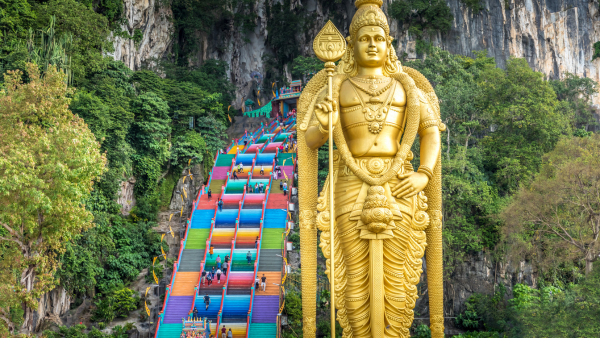
This 400 million-year-old cave site and temple in Malaysia is planning an escalator upgrade

The custodians of an ancient Hindu religious site in Malaysia are planning to install an escalator as an alternative for those visitors either unable or unwilling to climb the 272 steps leading to its temple and cave shrines. The Batu Caves are one of Malaysia’s most popular tourist attractions. They serve as a religious site for Hindu worshippers and are the focal point of the annual Thaipusam festival every year. Located a few miles north of the capital Kuala Lumpur, the site is thought to be around 400 million years old and is easily recognizable by its towering flight of rainbow stairs, which have made it popular with Instagrammers. To reach the temple housed in a limestone cave at the top, visitors must currently climb 272 steps. Adding an escalator would make the site “more accessible,” a spokesperson for the site’s management committee told a press conference Friday. “We hope the government will assist us since this (escalator) will allow the disabled and elderly who are unable to climb the steps to reach the main temple,” said temple committee chairman R. Nadarajah. Construction of the escalator, as well as a new “multipurpose hall” will begin after this year’s Thaipusam festival which falls on January 25, Nadarajah added. The hall is estimated to cost around 35 million Malaysian ($7.5 million), Nadarajah said. He did not say how much the escalator would cost.

Read more

Good News: Panipat Residents Can Now Travel for Free on Newly-Inaugurated Electric Buses for 7 Days

Haryana Chief Minister Manohar Lal Khattar on Sunday inaugurated electric city bus services in Panipat and announced that people will get to travel free of cost on these buses for seven days. Three electric buses have been introduced in the city and five more will be added to the fleet soon. Inaugurating the service from the new bus stand in Siwah, Khattar said the objective of this initiative is not only to provide convenient transportation to the people of the state but also to reduce environmental pollution. He announced that traveling on these e-buses would be free for the first seven days and encouraged people to opt for public transport over private vehicles According to the official statement, the service routes will be carefully planned, taking into consideration the demands and needs of residents. The fare will range from Rs 10 to Rs 50 and the route will cover a distance up to 30 kilometers, it said After launching the service, Khattar said the city bus service will be systematically expanded to villages surrounding the city. He said that after the launch of e-bus services in Panipat and Jagadhri, the government aims to start similar services in seven cities -- Panchkula, Ambala, Sonipat, Rewari, Karnal, Rohtak and Hisar -- by June 2024.

Read more

Govt plans biometrics-based immigration for international passengers

In a bid to position India's airports as major global transit hubs, the government is set to implement a biometrics-based system for international passengers to expedite immigration checks, according to a report by The Economic Times (ET). This policy, requiring Cabinet approval, aims to streamline laws, ease security and immigration bottlenecks, allocate international flying rights, and develop the necessary infrastructure to position airports like the one in the National Capital as competitive transit hubs. The biometrics-based system will include automated immigration clearances, which would eliminate the need for physical passport verification, as well as facial recognition or fingerprints to authenticate passenger identities. There are also talks of integrating the DigiYatra app into this process, which is currently being used to provide paperless journeys for domestic air passengers. The DigiYatra project, managed by the private non-profit body Digi Yatra Foundation, co-owned by the Airports Authority of India (AAI) and private airports, is actively working on a prototype for electronic passport-based enrollment. For first-time visitors to India, the enrollment process involves iris, facial, and fingerprint biometrics at manual counters, with subsequent trips benefiting from automated clearance routes. This system will initially be implemented at airports in New Delhi, Mumbai, and Bengaluru. This initiative will also initially be rolled out for international passengers only. Indian citizens will gain access after the government initiates the issuance of e-passports. E-passports will combine paper and electronic elements, featuring a radio frequency identification chip and antenna embedded in the back cover. Critical information on the passport will be both printed on its data page and stored in the chip. Full-scale manufacturing and issuance of electronic passports are expected to commence upon the completion of the technical ecosystem and infrastructure following successful testing. The issuance of electronic passports aligns with the Centre's goal to run India into an international hub for travel. The government also plans to offer single-point international connectivity for the entire South Asian region. In May last year, aviation minister Jyotiraditya Scindia stated that Rs 1 trillion would be invested in airports. He added that in the last nine years, 74 airports, heliports, and water aerodromes had been built to strengthen India's aviation sector.

Read more

8 ways travelling can improve your mental health

Traveling is not just about exploring new destinations; it can be a transformative experience for your mental well-being as well. Beyond the thrill of adventure and the joy of discovering new cultures, did you know traveling also offers several mental health benefits? Well, if you weren’t aware, here are eight ways in which a trip can positively impact your mental well-being. Travelling provides a break from the daily grind, allowing you to step away from stressors. Exposure to new environments, scenery, and activities can trigger the release of serotonin and dopamine, neurotransmitters that contribute to feelings of happiness and relaxation. The change of pace and scenery acts as a natural stress reliever. Mindfulness and presence Immersing yourself in a new place encourages mindfulness. Whether it's savouring the flavours of local cuisine, appreciating the beauty of nature, or engaging with a different culture, travel promotes being present in the moment. This focus on the present helps to alleviate anxiety related to future uncertainties or past regrets. Boost in creativity Exposure to diverse cultures and landscapes sparks creativity. The very idea of getting exposed to new experiences stimulates the brain, fostering creative thinking. Whether it's navigating through unfamiliar streets or appreciating unique art forms, travel ignites the imagination and contributes to a broader perspective on life. Enhanced resilience Navigating the uncertainties of travel, from flight delays to language barriers, builds resilience. Overcoming challenges on the road helps develop problem-solving skills and adaptability. These traits cultivated during travel can be transferred to daily life, making you more resilient in the face of adversity. Social connection Interacting with new people and cultures enhances social skills and fosters a sense of connection. Whether it's striking up a conversation with locals or bonding with fellow travellers, these social interactions can alleviate feelings of loneliness and create lasting memories. Building a network of positive social connections is crucial for mental well-being.

Read more

World's largest cruise ship begins maiden voyage: All you need to know about Icon of the Seas

As Icon of the Seas, the crown jewel of Royal Caribbean's fleet and the world's biggest cruise ship embarked on its highly anticipated maiden voyage from the Port of Miami, marking the beginning of a new era in luxury cruising. As the nearly 1,200-foot-long and 250,800 gross ton vessel set sail just before sunset, it captured the imagination of onlookers with its towering presence resembling a multilayered birthday cake. The ship's architectural grandeur, highlighted by its distinctive parabolic bow, promised passengers an extraordinary journey that seamlessly blends opulence, innovation, and breathtaking oceanic vistas. As Icon of the Seas gracefully glided into the open waters, the decks came alive with the excitement of a sold-out, seven-night island-hopping voyage in the tropics. This inaugural voyage, with its fusion of celebrity glamour and maritime splendor, sets the stage for what promises to be an unforgettable and groundbreaking chapter in the world of cruising. Icon of the Seas emerges not just as the world's largest cruise ship but as a floating haven of luxury and adventure, inviting travelers to indulge in the ultimate seafaring experience from the vibrant heart of Miami.

Read more

Air travel hit at Delhi Airport due to foggy conditions and low visibility – Check details

Northern states of the country have been experiencing thick fog conditions for a few days. On Monday morning, fog engulfed the national capital disrupting flight operations at Delhi International Airport. Several domestic and international flights have been delayed owing to the foggy conditions in several parts of the country, the Flight Information Display Board (FIDB) at Indira Gandhi International (IGI) Airport mentioned. The delays have been reported from international flights from Riyadh, Bangkok, Frankfurt, and Copenhagen Kashtrup among others. Domestic operations too got hit due to dense fog and adverse weather conditions, Delhi Airport FIDB showed. Fog to prevail over parts of the country Dense to very dense fog and cold day to severe cold day conditions are very likely to continue in isolated pockets of Punjab, Haryana, Chandigarh, and Uttar Pradesh. Dense fog conditions in isolated pockets are very likely to prevail for a few hours in the morning over Uttarakhand, north Madhya Pradesh, Sub-Himalayan West Bengal, Nagaland, Manipur, Mizoram & Tripura on January 29. On Sunday, Delhi recorded the maximum temperature of 18.6 degrees Celsius, normal for the season’s average. The minimum temperature of 6.0 degrees Celsius, three notches below the season’s average, was recorded in the morning. According to the IMD, from January 31 to February 1, the weather conditions will be generally cloudy with light rain or drizzle. From January 29 to 30, the city may witness moderate fog.

Read more