
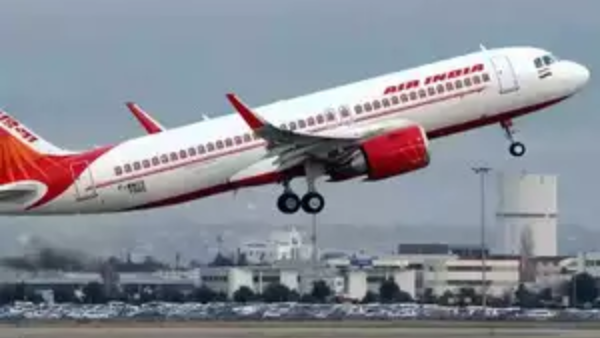
Air India enters intermodal interline agreement with Deutsche Bahn
- Nov 10,2023
- The Economic Times
Air India on Thursday announced that it has entered an intermodal interline agreement with WorldTicket, the exclusive distributor for Europe’s largest railway operator, Deutsche Bahn. With this collaboration, Air India passengers will be able to travel on a single intermodal ticket beyond Frankfurt with train connections to or from other cities and towns across Germany, including those without airports, on Deutsche Bahn. The agreement will allow travellers to connect to and from over 5600 train stations in Germany on the Deutsche Bahn network.Travellers can also take train connections on Deutsche Bahn to and from Amsterdam, Brussels, and Zurich via Air India’s Frankfurt gateway, said the airline in a statement. Travellers will get the benefit of the same baggage allowance on the rail routes as offered by Air India on its own flights. “We observe substantial passenger traffic on our Frankfurt flights that further connects to and from other German cities and towns, and this partnership addresses the needs of an increasing number of such guests. We are delighted to be working with WorldTicket and Deutsche Bahn in this effort,” said Nipun Aggarwal, Chief Commercial & Transformation Officer, Air India. Air India recently entered another similar intermodal partnership to provide travellers access to an extensive network of rail and bus operators in the UK, Italy, Austria, Belgium, and the Netherlands. WorldTicket is an IATA travel partner with its own AOC-holding airline, FlexFlight, bearing designator code W2, thus making intermodal journeys on a single ticket possible.
Read more
Get cheaper flight tickets this Diwali; airlines drop price as low as Rs 1,100
- Nov 10,2023
- Zee Business
As lower demand pushes commodity prices to drop, prices of flight tickets have plunged with Diwali around the corner. Airlines have now started rolling out offers to encourage more air travellers this festive season.Air fares have dropped nearly 40-50%, a report by Live Mint cited on Wednesday as a regular ticket from Delhi to Mumbai has been brought down to Rs 2,000 from around Rs 8,000The report further said that strong demand for flight tickets is generally noticed during tourist season, typically from the fortnight leading up to Diwali up till January 10. However this is not the case currently.Deals by airlines are now offering dirt cheap prices for as low as Rs 1,100 all-inclusive. Market leader, IndiGo is also offering low fares on the following routes of – Chennai- Bengaluru, Jammu-Srinagar, Delhi-Jaipur, Agartala-Guwahati, Coimbatore-Chennai, Bagdora-Guwahati, Goa-Bengaluru, Visakhapatnam-Hyderabad. The lowest fares start at near Rs 1,120 from Chennai to Bengaluru. The budget carrier has also begun its ‘early flight initiative,’ where travellers can avail of an early flight at just Rs 1,000 with ‘IndiGo Early.’ “This service is applicable to all passengers travelling on a domestic flight, wanting to prepone their flight (within 4 hours),” the company said. Vistara announced its sale offering all-inclusive flight fares starting at Rs 1,149 in economy class and Rs 2,099 in premium economy. All-inclusive airfare sale on domestic routes like Bengaluru, Kolkata and Ranchi are being offered by AirAsia. From Bhubaneswar to Ranchi the company is offering flight tickets starting at Rs 1,490. SpiceJet announced its ‘Cracking Diwali’ offer which gives 50% off on booking hotels and 60% cashback on making payments for hotels with HDFC bank credit cards. The offer is valid up till Diwali – October 19. Jet Airways on the other had has priced its fare in Premiere or business class from Mumbai to Delhi one-way all inclusive at Rs14,805.
Read more
Strong economy has nations vying to lure Indian tourists
- Nov 10,2023
- The Economic Times
Still waiting for that US or Schengen visa, wondering if you’ll get in time for the Christmas-NewYear holidays? How about Thailand, Saudi Arabia, Australia, Turkey, Vietnam or Sri Lanka? They are among countries banking on Indian travellers and looking to ease their entry. According to a McKinsey study released Thursday, globetrotters from India are set to soar, given the relative economic prosperity and a growing propensity for international travel. “If India follows China’s outbound travel trajectory (which it could, due to similarity in population size and per capita income trajectory), then Indian tourists could make 80 to 90 million trips a year by 2040,” said the report, From India to the world: Unleashing the Potential of India’s Tourists.Thailand announced this week that Indian travellers would not require a visa between November 10 and May 10. “We want more travellers to visit Thailand,” Tourism Authority of Thailand told ET in a statement. “In 2022, we received 965,994 Indian tourists. This year from January 1 till October 31 we received 1,302,483 Indian tourists.Saudi Arabia, which is heavily promoting itself as a globaltourism destination, had 1 million visitors from India this year up to September and is aiming for 2.4 million in 2024 from the country. “Flights frequency and capacity has been increased by 24% and 19%, respectively, this year compared to last year,” said Alhasan Aldabbagh, president of APAC markets at the Saudi Tourism Authority. “We have opened eight Tasheer offices (visa centres) in India to accelerate the visa process for Indian visitors. Indian passport holders that have UK, US and Schengen visas that have been used at least once will now be able to apply for a Saudi e-visa online.” Indian Premier League sponsorship is also being used to increase awareness and boost Indian visitors, he added Australia has made “significant efforts” to simplify, speed up and streamline the visa application process for Indian travellers, said Nishikant Kashikar, country manager, India and Gulf, Tourism Australia. Total trip spends of Indian tourists to Australia for the year ended June touched Rs 12,000 crore, an increase of 24% from that in the year ended June 2019, he said. “With the application process being completely digitised, we have also seen the Department of Home Affairs offering faster processing timelines for highquality visa lodgements and for well-travelled Indian citizens,” he said. “The absence of biometrics and no physical assessments required have become a huge advantage in this regard.” Türkiye has solidified its position as a premier destination for weddings and holidays for Indian travelers with convenient direct flights, said the Turkish Tourism Authorities. “The number of Indian tourists that Türkiye has welcomed in the first nine months of this year is 199,966,” it said in a statement. “We are optimistic about breaking previous records by hosting a substantial number of visitors this year.” Sri Lanka’s cabinet has approved free visas to visitors from India, China, Russia, Malaysia, Japan, Indonesia and Thailand as a pilot project till March 31, according to a post on X by foreign affairs minister Ali Sabry. “In 2023 till September this year, we got one million tourists. Indians comprised 20% of the arrivals. This is a big achievement,” said Jude Marsalin, Sri Lanka Tourism’s Indian market officer. Marsalin said participation in roadshows in Chennai, Ahmedabad, Bengaluru, Pune, Kolkata and at other travel events has helped raise awareness. "Bookings to Resplendent Ceylon from India have increased significantly over the last five years despite the periodic hiccups with Covid and the economic crisis in Sri Lanka. We have seen a 140% increase in revenue versus the same period last year," said Malik J Fernando, managing director, Resplendent Ceylon, a collection of boutique Relais & Chateaux resorts. Starting August 1, Russia started issuing electronic visas (e-visas) to Indian passport holders. As per reports, the move was aimed at helping visitors get travel approval faster for diverse purposes including tourism, business trips and guest visits. Robin Stangroom, chief commercial officer for The Set Collection, a group of luxury hotels in Amsterdam, London, Paris, JerusalemBeijing, Hong Kong, Chengdu, Shanghai, and Mexico said the year-on-year growth for the India market currently sits at 30%. India recorded an over 140% increase in visa applications last year over 2021, said Prabuddha Sen, chief operating officer, South Asia, at VFS Global. “With Covid restrictions and thereafter geopolitical sensitivities in some markets, many global destinations want to attract travellers from the country,” he said. “Some destinations such as Indonesia and Azerbaijan rolled out customised e-visa solutions for many nationalities including Indian nationals.” As per the McKinsey study, in 2019, Kolkata was the only city in India with direct connectivity to Vietnam, and three other Indian cities offered sporadic flights. That’s changed. “To stand out from South East Asian neighbours and gain popularity with Indian travelers, Vietnam improved direct connectivity from India by increasing flight frequency and adding new routes. Indian arrivals are now at an all-time high,” the study stated. Indians are travelling like never before, said Rajeev Kale, president and country head for holidays, MICE and visa at Thomas Cook (India). The company has seen a 200% surge in demand for the January-June period this year versus the year earlier. “A range of attractive destinations have emerged on their radar with the launch of direct flights to Vietnam, Azerbaijan, Kazakhstan,” Kale said. He cited new routes and increased connectivity on short-haul routes such as Bhubaneshwar-Singapore, Bangkok-Kolkata, Kochi-Ho Chi Minh City and longer ones such as IndiGo’s new Mumbai-Nairobi and Delhi-Tashkent flights. Daniel D’Souza, president and country head for holidays at SOTC Travel said SOTC has seen a robust growth of 227% for outbound travel between January – June this year versus the same period last year. "This significant growth is emerging not only from India’s metros and mini-metros, but also regional India’s tier two and three cities given rising disposable incomes coupled with the aspirational value of holidays," he added. And for that visa to the US? Keep waiting. “Despite the waiting time of over 500 days for a new US visa, we have over 200 applicants queuing up. Waiting time is about two months for some Schengen visas,” said Vijay Kesavan, founder and CEO of StampThePassport. “The easing of requirements by some countries in Asia should nudge a few more in the
Read more
Bhutan's festive season: 7 must-see festivals in the next six months to experience cultural splendour
- Nov 10,2023
- Hindustan Times
Bhutan's Department of Tourism is delighted to announce the commencement of the country's festive season, a period rich in cultural magnificence and spiritual celebration. From the mystical dances that bring to life Bhutan's ancient myths to the melodic rhythms that have echoed through the kingdom's mountains for centuries, these events provide an unparalleled window into the soul of Bhutan. Highlighting this season's calendar are seven marquee festivals, including the Black Necked Crane Festival, Bhutan Bird Festival, Druk Wangyel Tshechu, Punakha Dromche Punakha Tshechu, Paro Tshechu, and the Rhododendron Festival. The festivals will take place between November 2023 and April 2024, showcasing the rich tapestry of Bhutan's national identity and offering a warm Bhutanese welcome to all who wish to experience the country's living traditions. The annual Black-Necked Crane Festival will be held on November 11, 2023, in Gangtey valley (located less than four hours drive from Thimphu). The event celebrates the return of the magnificent black-necked cranes to Bhutan from parts of Tibet, China and Arunachal Pradesh, India. Attendees can look forward to witnessing mask dances such as Drametse Ngachham (mask dance of the drums from Drametse, eastern Bhutan), Pachham (Dance of the heroes), and Zhana Ngachham (Black hat drum dance). Furthermore, the festival also features various cultural performances by students, paying homage to the globally vulnerable Black-Necked cranes.This will be followed by the annual Bhutan Bird Festival from November 13-15, 2023 at Tingtibi in Zhemgang district, known as the eco-tourism capital of Bhutan, about a 6-hour drive from Thimphu. The three-day bird festival is a fascinating event, aimed to promote birding and upscale eco-tourism in the region and to enhance the local economy. The festival will feature cultural and entertainment programs by local bands, dancers and singers, mask dances and traditional Bhutanese music. Visitors can also participate in drawing competitions and traditional games, and enjoy hiking along the beautiful bird-watching trails. Beyond the festival ground, visitors have the option to go for healing hot-spring baths and recreational fishing (catch and release) using local traps or fly-fishing equipment. They can also go for white water rafting in the Mangde Chhu and Drangme Chhu basins.Following the bird festivals, the annual Druk Wangyel Tshechu will be held on December 13, 2023 at Dochula mountain pass, a short drive (45 minutes) away from the capital Thimphu. Against the breathtaking backdrop of the Himalayan mountain range, many sacred dances are performed at the festival retelling the bravery and sacrifices of the Royal Bhutan Army. The festival will feature various mask dances and traditional Bhutanese folk dances. Many unique dances are performed during the festival, making it different from other religious festivals nationwide. One of the most popular dances performed at the Druk Wangyel Festival is the dance of Gadpo and Ganmo-the dance of the old men and women, a dance of the heroes and the dance of guardian deities- which is performed in reverence of the main protector deities of dharma.The two most popular festivals in Punakha happen every year in the beautiful courtyard of the stunning fortress Punakha Dzong as the jacaranda flowers begin to bloom. Punakha Dromche will be held from February 16 to 18, 2024 and is a unique festival as it is the only festival in the country that dramatically reenacts a 17th-century battle against the Tibetan army. The festival features local militia men or 'pazaps' dressed in traditional battle regalia that is reminiscent of the time when in the absence of an armed force, eight great villages or 'tshochen' from Thimphu and Punakha came forward and expelled the invading Tibetan forces who had come to take away the sacred relic, Rangjung Kharsapani. The battle reenactment is then followed by a demonstration of 'norbu chushani' or immersion of relics in the Mo Chhu River. To hoodwink the Tibetan invaders, the 17th-century unifier of Bhutan, Zhabdrung Rinpoche is said to have dropped a decoy of the sacred relic into the Mo Chhu River. On the final day of Punakha Dromche a massive copper bowl inscribed with scriptures is dragged into the centre of the courtyard. The bowl is filled to the brim with alcohol which is then blessed and distributed to the people attending the festival. The three-day annual Punakha Tshechu will be held from February 19th to 21st, 2024, and is also held in the courtyard of Punakha Dzong. Punakha Tshechu, like all other tshechus, is held in reverence of Guru Rinpoche, the tantric Buddhist Vajra master, and is one of the most popular tshechus in the country. It is attended by locals and foreign visitors, as well as people from across the country. The tshechu will feature various mask dances or 'cham' and traditional Bhutanese folk dances. People dress in their best festival attire and families bring picnic lunches to come and watch the festival. Tshechus are one of the most significant and visible manifestations of the Bhutanese culture, art and traditions. The annual Paro Tshechu will be held on March 21-25, 2024 at the beautiful Rinpung Dzong in Paro, the district where the country's first and only international airport is located. The festival will feature various mask dances and traditional Bhutanese folk dances performed by both monks as well as locals. The main highlight of the festival is the unfurling of the immense embroidery of Guru Rinpoche (Guru Throngdrel) on the final day depicting the eight manifestations of Guru Rinpoche. The giant embroidery covers the entire three-story wall and many people queue up to view and get blessings from the throngdrel every year.On April 13-14, 2024, the Rhododendron Festival will be held at the Royal Botanical Park in Lamperi, about 35km from the capital Thimphu. The two-day rhododendron festival is an exciting event that marks the beginning of the spring season. It will showcase an exhibition of several types of blooming rhododendron species found in the park, spanning an area of around 50 km2. The main objective of the Rhododendron Festival is to celebrate the rich flora, culture and food of Bhutan, and create awareness on climate change and conservation of the environment. Bhutan has currently identified and recorded 46 species of rhododendron, including four that are endemic to Bhutan: Rhododendron kesangiae, Rhododendron pogonophyllum, Rhododendron Bhutanese, and Rhododendron flinckii. The Royal Botanical Park in Lamperi houses about 29 of these species. Nature-loving visitors looking for some opportunities to physically engage with nature can go forest-bathing along the Lungchutse hiking trail, about a 2-hour walk from the Dochula Pass. It's a beautiful trail with canopies of trees, and around the time of the festival will have stunning rhododendron flowers in full bloom. "We are thrilled to welcome visitors from around the world to partake in an extraordinary journey through the vibrant tapestry of Bhutanese festivities. Explore the wonderful palette of colours, laughter and unforgettable memories through numerous festivals that Bhutan hosts, be it religious festivals like Punakha Tshechu or modern festivals like the Bhutan Bird Festival. We invite you to immerse yourself in the joy and happiness that Bhutan has to offer," concluded Dorji Dhradhul, the Director General of the Department of Tourism.
Read more
Airbnb introduces features based on guest preferences; Global head (Ops terms India as high growth market)
- Nov 09,2023
- ET Travel World
Airbnb has announced new upgrades to its booking platform to make it more competitive with hotels, including revamping its ratings and reviews pages and highlighting guest favourites or homes with a near-perfect rating. Tara Bunch, Global Head of Operations, shares trends and details in an exclusive interview with ETTravelWorld. “The first big upgrade is the guest favorites, which is a new category,” said Bunch. “We have taken 2 million of our most loved Airbnb listings (the most dynamic ones from among 7 million listings) based on ratings, reviews, reliability, quality of the listing and highlighted the top guest favorites. “We are also revamping our ratings and review pages to include a number of new features that now allow guests to sort reviews and be able to see more relevant information,” shared Bunch on the second upgrade. The feature includes reviews based on distribution, star ratings, user and host behaviour and suggestions based on comparison of similar amenities, among others. “The idea is to make the listings more relevant and helpful for guests. We would like to give them much more visibility and a lot more information before they book,” she said. And, the third big upgrade is the listings tab. “This is for hosts,” said Bunch. The upgrade has these amenities organised into groups (like bathroom amenities, bedroom amenities outside amenities, kitchen amenities, living room amenities). “What has us excited is that not only will there be more information about the listing, it would also allow current hosts to go back and play with this new listings tab. This would help guests find all the amenities in the listing, and at the same time, help the host to highlight just how many amenities their listing has,” said Bunch. The other upgrades feature improved competitive pricing and feature comparison tools for hosts for more visibility. “The hosts would now be able to compare service fees, cleaning fees being charged by similar facilities. And the guests would be able to see which listing would give them the best deal in the same neighbourhood with similar size and amenities. We think this will really help hosts to ensure that they remain competitive from a pricing standpoint,” she said. “The other improvements for the host include an earnings dashboard and some new features around co-host messaging and co-host payouts being able to split them between, a host and a co-host,” added Bunch. While the Guest Favorites, revamped ratings and reviews, the new Listings tab, and additional upgrades for hosts will begin rolling out this week, hosts can try new features today by enrolling in Airbnb Early Access, AirBnb said. “India is one of our most important highest growth markets – both from a guest and host standpoint – and we are incredibly committed to this market. It is also an important market to us from a talent standpoint. We recently opened up the India hub tech hub in Bangalore and we continue to invest heavily there,” said Bunch. “From a growth standpoint, Asia Pacific as a region has fully recovered to pre pandemic levels. We are seeing great growth, gross nights growing 23% in Q3 of 2023 compared to 2019. That’s massive growth in such a large region. Nights and experiences booked grew 27% in Q3 compared to 2022 so that’s another big, large growth and impact,” she said. “On our part, we have been working closely with the local governments to highlight India and properties in India,” said Bunch. Airbnb recently signed a MoU with the Ministry of Tourism to showcase India’s rich cultural heritage through a spotlight on heritage stays across the country. At the state level, over the last year, it signed MoUs with Goa, Madhya Pradesh and Maharashtra, among others, to promote lesserknown destinations, conduct capacity-building workshops and raise awareness amongst communities on how to leverage their homes to reap economic benefits. “There's a lot of work happening in these areas. We are looking at these government partnerships as one of a critical approach to building the tourism ecosystem in India and through that also promoting more homestays,” she said. Women and economic empowerment “Hosting, a home or a room in your home in one of those areas, can create a lot of economic empowerment in smaller, maybe non-urban women. And more broadly, all Indians are particularly helpful in terms of spreading tourism to more rural communities, low density urban communities, and empowering local people who are looking for that extra money and can really help them make ends meet,” she added. Growing preference for hosted accommodations According to Airbnb, most popular outbound destinations for Indian travellers (based on nights booked data in India when comparing January 1 to September 30 2023, with the same period last year) were UK, US, Canada, UAE, France, Italy, Germany, Indonesia and Thailand. “North America and Western Europe have long been popular outbound destinations for travellers from India. These destinations also factor into the popular psyche by featuring in Bollywood films,” she shared. “Post pandemic we have seen different countries open up at different rates. But in Southeast Asia, we have seen a lot of growth in Korea and Japan. Travel and visas have become easier and people are feeling safe travelling. We saw domestic travel continue to remain pretty strong. And now we are seeing cross border travel increasing.
Read more
Denied boarding by airline? You may demand 400% compensation.
- Nov 09,2023
- ET Travel World
The Directorate General of Civil Aviation (DGCA) has issued a show cause notice to Air India for failing to adhere to regulations concerning the provision of facilities to passengers in cases of denied boarding, flight cancellation, and flight delay. The notice highlights the importance of passengers being aware of their rights in such situations. Passenger Rights: Denied Boarding and Compensation Passengers have the right to be informed about denied boarding, which occurs when an airline refuses to carry a passenger who has arrived for boarding within the specified time. However, it is important to note that if the airline has reasonable grounds, such as health, safety, security, or inadequate travel documentation, they may refuse boarding. Airlines are legally allowed to overbook flights, which may result in denied boarding. In such cases, airlines must first ask for volunteers to give up their seats. If no volunteers come forward, the airline can deny boarding to certain passengers. According to DGCA guidelines, if you are involuntarily denied boarding, the airline must offer you compensation, a confirmed seat on an alternate flight, and assistance like meals, accommodation, and transportation, depending on the circumstances. In the event of denied boarding, airlines are required to compensate passengers. If the airline offers an alternative flight scheduled to depart within 24 hours of the original flight, the compensation should be 200% of the basic fare plus the airline fuel charge, with a maximum of Rs 10,000. However, if the passenger chooses not to opt for an alternative flight, the compensation should be 400% of the basic fare plus the airline fuel charge, with a maximum of Rs 20,000. In addition, the passenger is entitled to a refund of the full value of the ticket. Air India's Penalty for Non-Compliance Last year, Air India was fined Rs 10 lakh by the DGCA for failing to compensate passengers who were denied boarding. This penalty highlights the seriousness with which non-compliance is viewed by regulatory authorities. It is crucial for airlines to fulfill their obligations towards passengers and ensure their rights are protected. Flight Cancellations and Compensation When flights are canceled, airlines have certain obligations towards passengers. They should either arrange an alternative flight that departs within two hours of the original departure time or provide a refund for the ticket. If a flight is canceled within a fortnight and up to 24 hours before departure, passengers should receive a refund and compensation ranging from Rs 5,000 to Rs 10,000, depending on the flight time. However, airlines are not obligated to provide compensation in the case of force majeure events, which are unforeseeable circumstances. To claim compensation,follow these key steps: Document Everything:It's crucial to document the situation. Keep a record of all communication with the airline staff, including boarding passes, tickets, and any information related to the denied boarding incident. This documentation will be valuable when you file a claim. Contactthe Airline:Inform the airline of your situation and inquire about the compensation you are entitled to. The airline should assist you in finding an alternative flight and provide compensation as per DGCA guidelines. Make sure to get a written confirmation of the assistance and compensation offered.File a Complaint:If the airline fails to provide satisfactory compensation, you can file a formal complaint with the airline and the DGCA. Ensure you provide all relevant documentation and details, including your flight information, reasons for denial, and your contact information. Seek Legal Assistance:If the airline continues to deny your rightful compensation, consider seeking legal assistance or contacting a consumer rights organization. They can guide you on how to escalate the matter and take appropriate legal action if necessary.
Read more